Sunday, September 8, 2013

In Which I Lost My Cool

There's a professor at our school. I don't want to use his name, so let's call him Professor McDrunkerson. This teacher is, as you have probably guessed, always drunk. He has a serious problem with alcohol, to the point where his wife and child left him since he was no longer buying food for the family -- instead he spends it all on liquor. He regularly skips most or all of his classes -- we're about halfway through the trimester, and I've seen him at school maybe three times. On the days when he is in class, he saunters into class smelling of gin, scrawls something illegible on the board, tells the students to copy it, and puts his head down on the desk and naps the rest of the time. No explanation, nothing. At the end of the trimester, he completely makes up the grades -- a 10 is a passing grade here, and if you look at his grade sheet, it goes like this: "10, 10, 10, 11, 10, 10, 9, 10, 10, 10, 12, 11". No student, even the incredibly smart ones that have 18's and 19's in all their other classes, scores higher than a 12. But at the end of the trimester, 90% of his students passed Portuguese, and that's apparently all that counts.

We had a staff meeting on Friday morning. I don't teach on Fridays and I was anxious to get into the city to meet Szasha, but I decided to stick around for this meeting in case it was important.

"We have a very big problem," my director said after everyone sat down. "The pass rate for our students went down last trimester. First trimester, 82% of our students passed. But last trimester, only 74% passed. This is unacceptable. Let's talk about what we can do to raise this percentage. First, I'd like to hear your opinions -- why is this happening?"

Several of the teachers piped up with ideas.
  • It's harvest time, and a lot of students are missing school.
  • When students do show up, they come late and they leave early.
  • We have no books to use in the classroom. 
  • We're getting into more difficult material and students don't know how to study effectively.
  • Many of the students that come from the feeder schools in the mato (the bush) still don't know how to read and write in 8th grade.
These are all very real concerns for the teachers at my school, and yet my director brushed them aside and said, "These are challenges that we all face, and yet some teachers are doing better than others. What can we do to make the teachers that are behind improve their pass rates?"

Now, I'd like to state at this point that I'm incredibly lucky to have colleagues that actually work -- many of the horror stories that I hear from other volunteers would never happen here. Generally, most teachers here show up to school every day, and they actually teach. Some of them even teach well.  These are the ones that give tests that actually test what was learned in class. These are the teachers, of course, whose pass rate accurately reflects student knowledge and achievement.

Then my director started reading a list of each teacher and their pass rate, starting from lowest and going to highest, and guess who had the highest pass rate? With 90%, it was Professor McDrunkerson. I felt a communal shift in atmosphere to what I would call "incredibly pissed off." (Three guesses as to who was the only professor absent from this meeting?) And yet, no one was saying anything! What's wrong with them? I thought. Why don't they stick up for themselves? This is ridiculous! 

Then I though back to a time when I was working for just over minimum wage for a boss that just loved to yell at people who didn't deserve it, and I understood why these people were staying silent. This job is these people's livelihood. Mouthing off to the boss could get you fired, and then where's the food for your family going to come from?

Unlike colleagues, though, I don't depend on this school for my salary. Heck, I don't get a salary. So I raised my hand.

"Excuse me," I said, "But let me see if I have this straight. The thing that's worrying you is our pass rate, yes?"

"Yes," said the director.

"OK. But let me ask you, what is this statistic really showing us? You're saying that the teachers with the lowest pass rate are the worst teachers and the ones with the highest are the best?"

"Yes."

"All right, well, I have several objections to that. First of all, I know for a fact that some of the teachers with low pass rates are excellent teachers. Secondly, are you seriously trying to tell us that you think the best teacher in the Secondary School -- the best our of all of our teachers, is Professor McDrunkerson!?"

A stunned silence followed my outburst. "Did she really just say that?" whispered a few teachers.

And then the room exploded. People were laughing, shouting "Yeah!" and "Exactly!" and a couple of them reached over to give me a high-five and shake my hand. My director looked most seriously displeased.

I very rarely speak during these types of staff meetings. I also very rarely raise my voice in general. I don't like being the center of attention, and my hands were shaking a bit when I sat down. And yet, I'm glad I said something. I've been in these teachers' shoes, completely at the mercy of a tyrannical supervisor, and it's not at all fun.

At the moment, my relationship with my director is a bit strained, but it'll pass. He's gone for the weekend, but I plan on going to talk to him on Monday, and tell him this: If you want to have a staff meeting about how we can improve the quality of our students learning, I'll be there, supporting you 100%. But I will not stand by and listen to the very teachers who are actually doing their jobs get berated. Let's focus less on statistics and focus more on what's behind those numbers.

The one bridge I think I've permanently burned is with Professor McDrunkerson. But on a scale of one to one hundred, you know how much I care about that?

Zero.

Thursday, September 5, 2013

Bemvindos, Moz 21!

In the weeks before my departure for Peace Corps, I was doing part-time technical work at a community theater in San Antonio, crossing off each passing day on my "Countdown to Peace Corps" calendar on my desk. It seems like yesterday that I would get in my car with my Starbucks iced white chocolate mocha, and sing along to show-tunes down I-35 on the way to work.

It may seem like yesterday, but in fact, that was almost a year ago. Hard to believe!

In less than three weeks, the newest cohort of volunteers, Moz 21, will arrive in Mozambique for training. The new trainees all extremely excited, panicking about what to expect when they get here, trying to cram in quality time with family and friends before leaving, and freaking out about what to pack and what not to pack. We current volunteers are equally as excited for them to get here -- both because it means that we will no longer be the young'uns of Education, and also because it'll be super exciting to get a whole group of new people in Mozambique. I in particular can't wait to meet my new roommate and the 6 other volunteers that will be joining me in Tete in December.

Naturally, the new trainees are in a packing craze at the moment. In the weeks leading up to departure, current volunteers love to tell future trainees things like "Don't worry about packing. Just spend time with your friends and family. That's much more important!" While that's true, I remember the weeks leading up to departure. You have no idea what to expect after the minute you step on the airplane on the way to Staging. The only thing you can control is what you pack and how you prepare.

So here are my two cents on preparing for Peace Corps service for Moz 21.

1. Mozambique (and Africa in general) is probably not going to be as rustic as you expect.
Before coming to Mozambique, I had images of living in a reed hut in the middle of nowhere, surrounded by people with crazy tribal tattoos and neck rings. Mozambique is not like that. Most education volunteers live in decently sized towns and villages, and while some of us do live in huts without electricity, we all have laptops and almost all of us have regular internet access both on our laptops and smartphones. You won't need your safari hat and cargo pants nearly as much as you'll need nice shirts (polos, blouses, etc.) and professional shoes (Ladies, flats and sandals are your best friends.)

2. Plenty of people live here without "American" things. You don't need to bring everything.
You can get most anything in the bigger cities here, including clothing, food, toiletries, etc. Aside from the fact that millions of Mozambicans live here without a problem, there are also a decent number of expatriates who manage to live a relatively "Western" lifestyle here. This especially applies to clothes -- you will acquire a ton of T-Shirts, and probably a bunch of nice clothing from the thrift market, calamidades, that any decently-sized community has. If your bags are overweight, take out some clothing.

What can't you get here? Certain food items, depending on where you live. (The care package that my mom sent me with Parmesan cheese vastly improved my quality of life.) Electronics are available but of questionable quality and overpriced. Quality kitchen items, like sharp knives and nonstick pots. Specialty hobby items. Sentimental things.

To give a visual, I looked around my house recently and thought about which things I brought from the U.S. I use the most and am most grateful that I brought. Here's what I came up with (in no particular order):

1. Art supplies (since I like to draw) 2. A good camera. 3. Kindle -- I use it every day, much more practical than books. 4. Journal for recording accomplishments and frustrations. 5. Children's books for my neighbors and local kids to read. 6. Laptop with external hard drive. You'll acquire a lot of media. 7. Shoes for people with large feet -- ladies, it's hard to find big shoes around here. 8) Photo album of family and friends -- both for your emotional sanity and to show off to your neighbors. 9. Music player and portable speaker. Especially the speaker. I can't count how many times that little guy has come in handy.
On the other hand, things I needn't have bothered bringing include a solar charger (most sites have electricity, and you can buy them here), too many t-shirts (you'll get t-shirts for all kinds of events and such), and excess medical supplies (Peace Corps gives you a pretty extensive medical kit.)

3. 27 months may seem like a long time, but it is going to fly by. Relish it.
Especially at the beginning, you're going to have a hard time. There will be days when you want to go home. There will be days when you think "Why, why, WHY did I choose to do this to myself?" Please believe me when I say that it only gets better. Talk to someone if you're having a problem. We have a Peer Support Network in country for you to talk to if you're feeling stressed. (I'm on it, so call me anytime! You'll get all of our numbers during training). We have a new trainee mentoring program so you'll have someone who can listen to you.

If you stick it out, be tough, and roll with the punches, you will get through the rough patches and you will grow to love Mozambique, your life here, and your community. It's going to be one of the most rewarding feelings in your life.

We can't wait to meet you!


WELCOME TO MOZAMBIQUE, MOZ 21!

Monday, September 2, 2013

2013 Tete REDES Workshop: Success!

After lots of preparations and organization, the day finally came for our Tete REDES Workshop to start! The workshop had been postponed from mid-July due to the political unrest, and there were a couple of bumps along the way in planning and execution, but on August 23rd, twenty-four bright-eyed and excited girls showed up at our school in Mavudzi-Ponte, excited to spend a weekend together learning about life skills and women's empowerment.

Szasha's girls sing on the bus on the way to the conference.
First order of business: Give each girl a T-Shirt!
More like a dress. This was actually the smallest size.
 Gosh, just take a look at those t-shirts. Whoever designed them must be a creative genius. 

Our weekend was packed full with sessions and activities for the girls to do. There were songs to be sung, games to be played, health information to be learned -- so much to do in just one short weekend!

Singing the REDES Anthem

Redi discusses HIV/AIDS transmission and women's health.
Some of the girls were a little shy at the beginning. Talking about thins like women's health, safe sex, HIV/AIDs and other sexually transmitted diseases is not something that's usually done in Mozambique. And when the topic is approached, its usually just adults throwing information and advice (often fallacious) at young girls. Our facilitators tried to keep it casual, and get the girls to open up, and use games to motivate participation. Our girls soon got much more interested as soon as it became a competiton.

"True or false? A girl cannot get pregnant if it's her first time having sex."
Got the answer right!
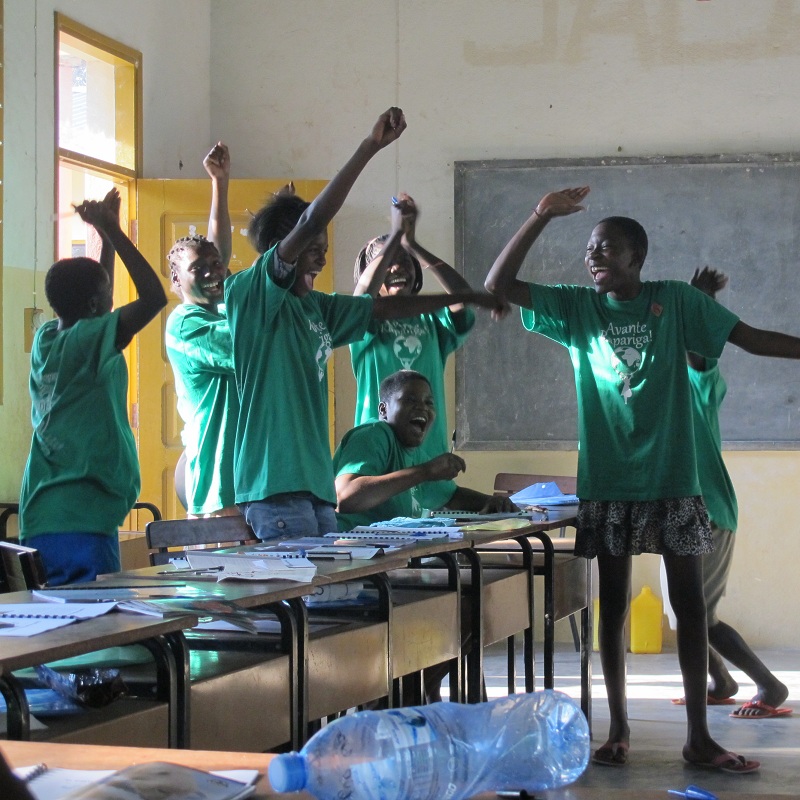
Celebrating a team victory in the Puberty Quiz Game.
In addition to life skills, a large component of the REDES workshop is income generation. We want the girls to have the skills and resources to start a small business in their town. For our workshop, my girls have been practicing the cross-stitching we learned this year, and finally had a chance to show off their skills while teaching the other girls. Redi did a cross-stitching demonstration, and then the girls all got to try their hand at it. Very few actually managed to make the small heart-shape pattern we provided, but all of them had a blast and said they'd keep trying at home.

String confusion.
Redi helps one of the younger girls.
Szasha gives out stickers for a job well done.
After finishing all of our sessions, it was picture time! People here just love to have their picture taken, though it's not part of the culture to smile in photos. I took one "Mozambican" photo of each group (where they are all glaring) and then told them that they had to smile so big I could see all their teeth for the "American" photo. Naturally, we took a couple of silly photos too.


Our whole REDES group!

Our silly picture.

Me with my two co-facilitators, Vanda (left) and Redi (right)
All the Tete Province group facilitators.

"Szasha and Helen: the inseparable volunteers."
The whole group!
After all that sitting around, the girls had some pent-up energy to expel. What better way to unleash it than to have a volleyball and soccer tournament? A bunch of the neighborhood kids came by to watch the volleyball game, and they got especially excited when the girls finally managed to talk me into joining one of the teams. I haven't played volleyball in a long time, but it was a ton of fun!

Getting pumped for the game.

Contesting a call by the judge.

A sassy spectator.
Celebration of the winners!

All all that excitement, the girls were hungry. Thankfully, our fantastic cook, Laurita, was on the ball making three meals a day for thirty people. 

Laurita makes delicious feijão.
Peeling an entire bucket of potatoes is hard work!
Refeuled from dinner, what better way to end a great day than with a dance party? I was noticeably absent from said dance party, since,

1) Mozambicans LOVE to make fun of White People Dancing.
2) I was wrestling with my newly-broken computer
3) I was busy chasing annoying neighborhood children away from our event, threatening to hit them with a stick. (What has Mozambique done to me!?)


Redi boogies with the gals.
 After two full days of learning, bonding, dancing, making friends, playing, and giggling, the conference finally came to a close on Sunday morning. We had a small ceremony, where each girl got a certificate, we thanked the facilitators for all their hard work, and we sent the girls on their way home, hopefully with a bit more wisdom and some new skills.

Mozambicans LOVE certificates.
Everyone left, and I remained behind with a completely messy classroom, a sweaty and dirty shirt, and a severe case of sleep deprivation. Still, I was over the moon -- our conference was a resounding success. Since this was the first big event I've planned, and it was for the most part me doing the logistics and organization, I was very worried something would go horribly wrong. But it didn't! The girls had a blast, I had a blast, and I can't wait to do this again next year.

But someone else can plan it, then.